
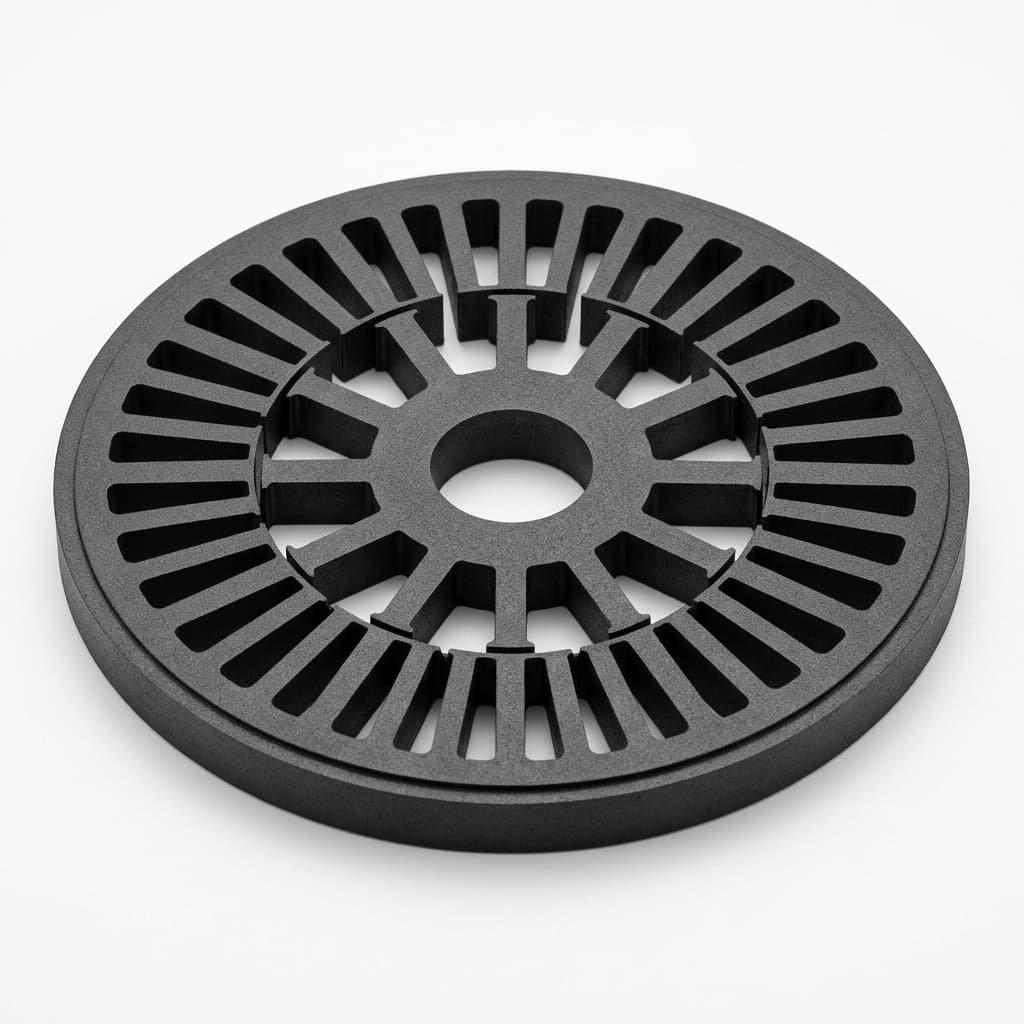
Sourcing Dual-Rotor Axial Flux Motors: An OEM Buyer's Guide
An engineering guide for procurement and engineering teams on how to specify, validate, and source dual-rotor AFPM motors from reliable OEM manufacturing partners.
The Dual-Rotor Axial Flux Permanent Magnet (AFPM) motor—typically featuring a single coreless or yokeless stator sandwiched between two rotating magnet disks—provides maximum torque density in modern electric machine design. It is the architecture of choice for high-end hypercars, advanced eVTOL drones, compact humanoid robotics, and specialized marine propulsion.
Executive Summary for Sourcing Teams:
Sourcing a dual-rotor AFPM motor requires scrutinizing the OEM's capability to manage extreme axial magnetic forces (>5,000 N) and thermal bottlenecks. Key RFQ checkpoints include rotor deflection analysis, magnet retention strategies (to prevent Eddy current overheating), stator potting techniques (Class H/N VPI), and tooling flexibility for custom KV ratings.
Dual-Rotor AFPM Architecture (Exploded View)
However, transitioning from a theoretical design in Maxwell or Motor-CAD to a reliable, cost-effective production supply chain is challenging. If your engineering team has specified a dual-rotor AFPM motor, your procurement team needs to know exactly what to scrutinize when qualifying an OEM manufacturing partner.
Here are the four critical manufacturing hurdles you must evaluate during the RFQ process.
1. Validating Structural Deflection and Airgap Control
The most critical manufacturing challenge of a dual-rotor AFPM motor is managing the immense axial attractive force between the two rotors. High-grade neodymium (NdFeB) magnets on opposing disks are constantly pulling toward each other with forces that can easily exceed several thousands of Newtons, depending on the motor diameter.
A slight deflection in the rotor disks (backing plates) or a minute tolerance error in the thrust bearings can cause the airgap to close. If the spinning magnets contact the stator, the motor destroys itself instantly.
Buyer's RFQ Checklist: Deflection & Bearings
- What is the maximum calculated deflection of your rotor backing plate under full magnetic load?
- Do you use finite element analysis (FEA) to design the rotor hub for structural stiffness vs. weight optimization?
- What bearing architecture (e.g., angular contact bearings, crossed roller bearings) are you specifying to handle these extreme continuous axial loads?
2. High-Speed Magnet Retention and Eddy Current Losses
In an axial flux motor, the magnets are mounted on the flat face of the rotor disk. As RPM increases, centrifugal forces shear the magnets outward. At high electrical frequencies, the magnets themselves can heat up rapidly due to Eddy currents induced by stator slot harmonics.
Buyer's RFQ Checklist: Magnet Retention
- Do you use segmented magnets (slicing a single pole into 3-4 smaller pieces) to interrupt Eddy current paths and prevent the NdFeB from overheating and demagnetizing?
- Are the magnets retained using a 0.2mm carbon-fiber sleeve, fiberglass banding, or precision-machined rotor pockets?
- What is the maximum safe operating speed validated through burst-spin testing?
3. Stator Manufacturing: Winding, Litz Wire, and Thermal Bottlenecks
In a dual-rotor design, the stator is trapped in the middle. It generates the vast majority of the heat, but has very little surface area exposed to ambient air. To combat high-frequency skin effects, many high-end AFPM motors require Litz wire (hundreds of individually insulated microscopic copper strands twisted together) or perfectly aligned rectangular wire.
Buyer's RFQ Checklist: Stator & Thermal
- Do you have automated winding capabilities for flat rectangular wire to achieve >70% copper fill factor, or automated Litz wire handling?
- How is the stator cooled? (e.g., edge-cooling via an outer aluminum ring, direct liquid cooling channels, or dielectric oil flooding?)
- Are you using Class 200 (Class N) thermal epoxy during the Vacuum Pressure Impregnation (VPI) process to ensure zero air voids?
4. Customization Flexibility and Tooling Costs
Unlike radial motors—where you can simply stack more standard silicon steel laminations to increase the axial length and power of the motor—modifying an axial flux motor often requires completely new, expensive tooling for the rotor disks, stator molds, and housings.
Buyer's RFQ Checklist: Cost & Tooling
- If we need a custom KV (RPM/V) rating to match our inverter's DC bus voltage, can you adjust the winding turns without changing the entire mechanical package or triggering new mold fees?
- What is the lead time for a custom prototype vs. a pilot run of 100-500 units?
- Do you handle custom shaft outputs (splined, hollow shaft, custom flanges) in-house?
Partnering with AFPM Motor
Manufacturing dual-rotor AFPM motors requires specialized process control, especially around stator winding, vacuum resin potting, rotor balance, airgap control, and magnet retention. Buyers should not assume a standard radial motor supplier can transfer the same fixtures and inspection plan to a pancake motor program without additional validation.
At AFPM Motor, RFQ reviews focus on the axial flux details that most often create sourcing risk: dynamic balancing of dual-rotor assemblies, thermally conductive stator potting, magnet retention, housing stiffness, and manufacturable acceptance criteria. The goal is to turn a drawing or target torque-speed map into a DFM review, sample plan, and pilot-lot evidence package before scale-up.
Ready to evaluate a supply chain for your next dual-rotor electric drive? Explore our OEM capabilities and send us your RFQ today.
Author

Categories
More Posts
AFPM Motor Sizing for AGV and AMR Wheel Drives: A Direct-Drive Selection Guide
Engineering guide for specifying axial flux wheel hub motors for AGV, AMR, and mobile robot platforms — covering torque sizing, gear elimination, encoder integration, and IP protection.
Axial Flux vs. Radial Flux Motors: A Detailed Engineering Comparison
An engineering analysis of the technical differences, torque density advantages, magnetic flux paths, and manufacturing tradeoffs between axial flux and radial flux permanent magnet motors.

Scaling Axial Flux Motors in 2026: How the EU MAXIMA Project Addresses Manufacturing and CRM Constraints
Analysis of the EU MAXIMA Project's 2026 advancements in reducing 60% CRM and using modular design to overcome mass-production bottlenecks in axial flux motors.