
Hybrid tool + report
20kW Axial Flux Motor Calculator
Screen a 20kW axial flux motor operating point first, then use our evidence-backed report to judge peak power limits, continuous duty requirements, and application fit for your light EV, drone, or motorcycle project.
Decision summary
20kW Integration Realities
A 20kW rating requires careful integration planning around bus voltage, DC bus current, phase current limits, and thermal management.
Treat 20kW as a duty-cycle claim
A 20kW axial flux motor can mean short burst output, intermittent operation, or true S1 continuous duty. Before comparing suppliers, require the rated duty type, burst duration, rest period, coolant conditions, and derating curve.
20kW S1 needs thermal proof
For a sealed hub, marine pod, pump, or industrial fan, do not accept a 20kW label without winding temperature limits, thermal sensor placement, coolant flow, ambient temperature, and steady-state test data.
Use DC bus current for pack sizing
At 20kW output and 94% assumed efficiency, the estimated DC input current is about 443A at 48V, 222A at 96V, 148A at 144V, and 53A at 400V. Actual phase RMS current depends on motor constants, modulation, and inverter limits.
Quote mass with cooling and rating basis
Power density comparisons are only useful when the supplier states motor mass, controller mass if integrated, coolant hardware, peak versus continuous rating, and the test point used for the efficiency number.
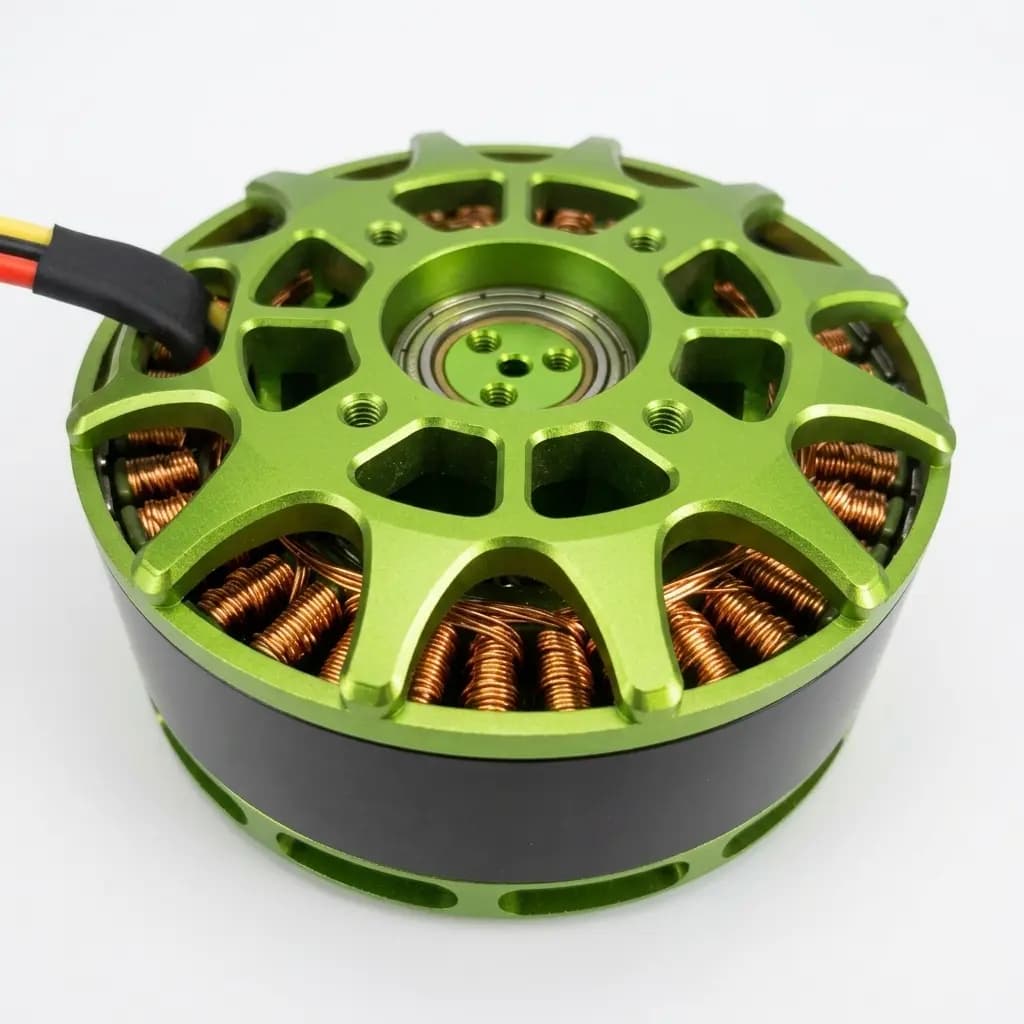
System boundary
Air vs Liquid Cooled Duty Cycles
The difference between a 20kW peak motor and a 20kW continuous motor depends on the verified duty cycle, coolant conditions, and thermal dissipation path.
| Architecture | Estimated DC Bus Current | Cable / DC-Link Impact | Integration Note |
|---|---|---|---|
| 48V DC | ~443A | Very high current | Heavy DC cabling and high-current inverter required |
| 96V DC | ~222A | About half of 48V | Moderate |
| 144V DC | ~148A | Lower current | Cleaner fit for compact traction packs |
| 400V DC | ~53A | Low current, higher voltage class | Useful for industrial drives with proper insulation design |
Evidence and method
Application Benchmarks & Risks
Evaluate real-world deployment data and critical integration risks before finalizing your powertrain.
RFQ Evidence Checklist
| Spec Area | Ask For | Decision Value |
|---|---|---|
| Rating basis | Continuous S1 kW, peak kW, S2/S3 duration, rest period, and ambient temperature | Separates true 20kW continuous packages from short-burst traction ratings. |
| Cooling circuit | Coolant type, flow rate, pressure drop, max winding temperature, and sensor placement | Shows whether 20kW can be sustained without thermal derating. |
| Electrical interface | DC link range, inverter phase RMS/peak current, connector type, and cable size | Prevents DC bus current from being confused with motor phase current. |
| Torque-speed map | Peak and continuous torque curves, base speed, efficiency map, and field-weakening limit | Confirms whether your operating point stays inside the efficient envelope. |
| Mechanical package | Motor mass, outside diameter, axial length, shaft loads, bearing rating, and IP rating | Validates packaging, power density, and axial-load risk together. |
Worked Screening Examples
| Application | DC Voltage | Speed | Torque | DC Current | RFQ Note |
|---|---|---|---|---|---|
| Light EV / go-kart | 96V DC | 3,000 rpm | 63.7 Nm | ~222A | Good first screening case when pack current, connector rating, and burst duration are explicit. |
| Electric motorcycle | 144V DC | 5,000 rpm | 38.2 Nm | ~148A | Lower DC current than 96V while still requiring verified inverter phase-current limits. |
| Heavy-lift drone | 120V DC | 2,500 rpm | 76.4 Nm | ~177A | Propeller inertia and axial bearing load become RFQ items, not afterthoughts. |
| Industrial pump | 400V DC | 1,500 rpm | 127.3 Nm | ~53A | Cleaner current level, but S1 continuous thermal proof and insulation design are mandatory. |
Common Integration Risks
Risk: Thermal runaway in enclosed hubs
Trigger: Running continuous 20kW in an unventilated wheel hub or sealed marine pod.
Mitigation: Implement active thermal throttling in the controller and ensure thermal potting of stators.
Risk: High DC bus current melting connectors
Trigger: Using 48V systems for sustained 20kW loads, about 443A at 94% efficiency.
Mitigation: Migrate to 96V or 144V architectures, size DC links and phase leads separately, and use bolted high-current connections.
Risk: Bearing failure from axial loads
Trigger: Direct mounting of large drone propellers transferring shock and gyroscopic loads directly to motor bearings.
Mitigation: Use heavy-duty thrust bearings or isolate the propeller shaft from the motor bell.
Frequently Asked Questions
Sizing and operation
What is a realistic weight for a 20kW axial flux motor?
There is no safe single weight without a duty-cycle basis. A short-burst traction motor, an air-cooled motorcycle motor, and a liquid-cooled S1 industrial motor can all carry a 20kW label but have very different mass and cooling hardware.
Can I run a 20kW motor on a 48V battery?
It is technically possible, but the DC input current is about 443A at 94% efficiency. That drives heavy cables, high connector stress, and inverter cost, so 96V or 144V is usually a cleaner starting point for 20kW systems.
Is 20kW enough for an electric car?
For a full-size passenger car, no. However, 20kW is plenty for golf carts, electric go-karts, neighborhood electric vehicles (NEVs), and lightweight motorcycles.
Do I need liquid cooling for 20kW?
If 20kW must be sustained as S1 continuous duty, ask for a liquid-cooling or equivalent thermal validation package. If 20kW is only a short acceleration burst, air cooling may be acceptable when the supplier states the burst duration and rest period.
Supplier evidence and integration
What should I ask a supplier before buying?
Ask for the duty-cycle rating, torque-speed map, efficiency map, winding temperature limit, cooling data, DC voltage range, phase current limits, mass, bearing load rating, and validation report for your target application.
Why does the calculator show DC bus current instead of phase current?
Battery and DC-link sizing starts with input current, calculated from output power, voltage, and efficiency. Phase RMS current depends on winding constants, inverter modulation, and control strategy, so it must come from the motor and inverter datasheets.
Is axial flux always better than radial flux at 20kW?
No. Axial flux can be attractive when axial length, torque density, and direct-drive packaging matter. Radial flux can still be better when cost, manufacturing maturity, sealing, or high-volume sourcing dominate the decision.
When should I choose torque mode instead of RPM mode?
Use RPM mode when the application speed is fixed, such as a pump, propeller, or geared wheel target. Use torque mode when the load torque is fixed and you need to know what speed would deliver 20kW.
Sources & References
IEC 60034-1:2026, Rotating electrical machines (Published 2026-03; reviewed July 25, 2026)
Key Finding: Use formal rating and performance language when separating continuous operation from peak or intermittent duty.
Confidence: High for rating framework; the IEC listing is not a free 20kW axial-flux datasheet.
IEC publication listingIEC 60034-1 duty-cycle summary (Reviewed July 25, 2026)
Key Finding: S1 continuous, S2 short-time, and S3 intermittent periodic duty describe different thermal operating conditions.
Confidence: Medium; secondary technical summary aligned with IEC terminology, not a replacement for the standard.
Duty-cycle summaryMercedes-Benz axial flux motor production release (Published 2026-06-09; reviewed July 25, 2026)
Key Finding: Series-production axial-flux manufacturing shows the topology is moving into validated high-performance drivetrain programs.
Confidence: High for production-adoption context; medium when extrapolated to a custom 20kW procurement decision.
Mercedes-Benz releaseNidec motor fundamentals (Reviewed July 25, 2026)
Key Finding: Voltage, speed, load, and current interact through motor back-EMF and torque behavior, so DC bus current is not the same as phase RMS current.
Confidence: Medium; principle-level DC/BLDC reference, final phase current still needs motor constants and inverter data.
Nidec motor guideAFPM Motor 20kW screening model (Updated July 25, 2026)
Key Finding: Uses torque = 9549 x P(kW) / rpm and DC input current = Pout / (Vdc x 0.94) for first-pass RFQ screening.
Confidence: High for arithmetic; medium for real hardware until verified on a dyno and thermal bench.
Open calculatorRFQ closeout
Turn the 20kW Screening Result into an RFQ
Send the target voltage, torque-speed point, duty cycle, cooling boundary, shaft load, package envelope, and validation target so AFPM Motor can review feasibility against a real manufacturing path.
Send 20kW RFQ Data