
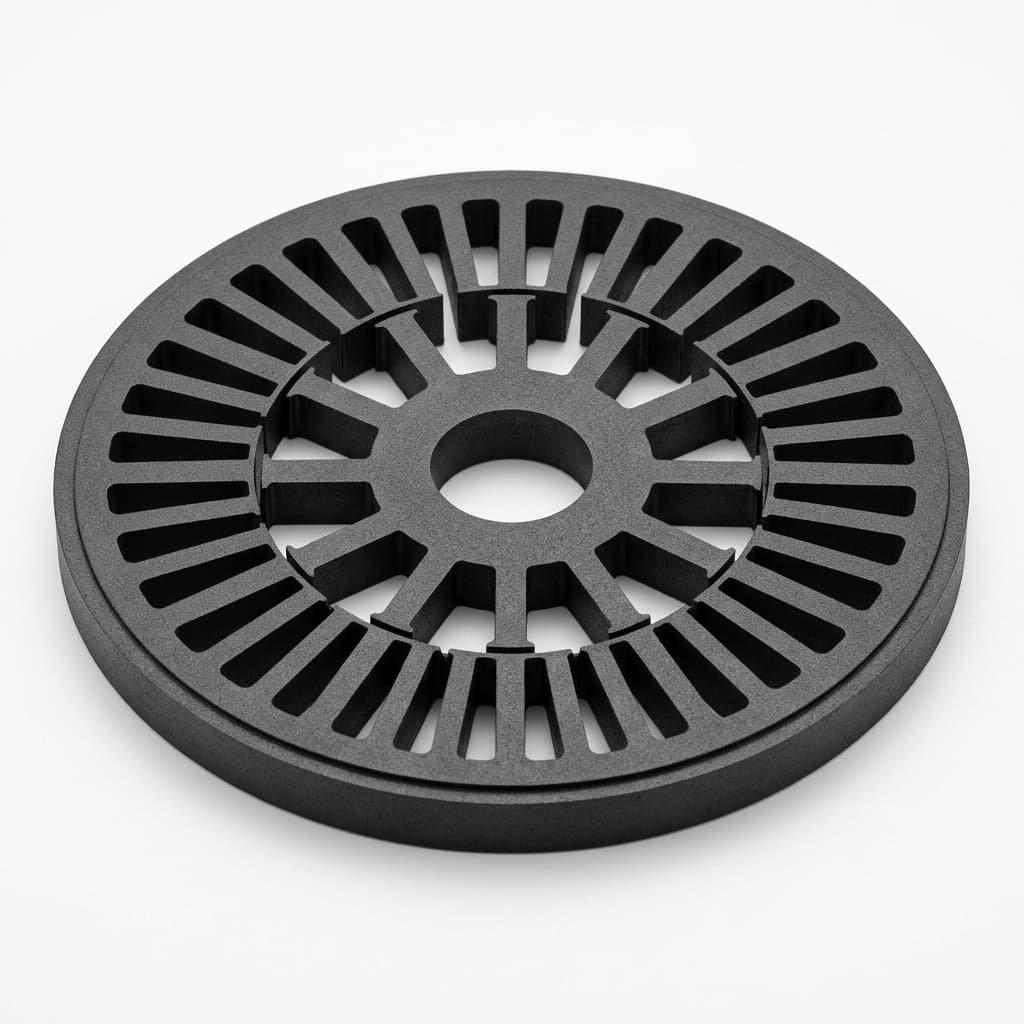
Soft Magnetic Composite (SMC) vs. Laminated Electrical Steel in Axial Flux Motor Stators
Compare SMC and laminated electrical steel for axial flux motor stators: flux paths, losses, scrap rates, sourcing checks, and when to contact AFPM Motor.
The transition from radial to axial flux permanent magnet (AFPM) motors has introduced a fundamental disruption in motor manufacturing. While the architecture delivers unmatched torque density and compactness, it also exposes the severe limitations of traditional laminated electrical steel. The defining challenge of AFPM design is managing the three-dimensional (3D) path of magnetic flux.
For decades, the industry standard for motor stators has been thin sheets of silicon electrical steel, stacked and bonded. However, as OEMs push for higher power densities and lower bill of materials (BOM) costs, Soft Magnetic Composites (SMC) have emerged as a disruptive alternative. SMC materials—iron powder particles coated with an electrically insulating layer and pressed into shape—offer unique advantages in 3D flux management, high-frequency operation, and zero-waste manufacturing.
This guide provides engineering and procurement teams with a deep dive into the technical trade-offs, cost implications, and supply chain realities of SMC versus laminated steel in axial flux motors.
Executive Summary for Motor OEMs and Procurement Teams:
Laminated steel offers superior permeability and saturation flux density but severely restricts stator geometry and incurs massive manufacturing waste (often exceeding 40% scrap). Soft Magnetic Composites (SMC) allow for net-shape pressing of complex 3D stators, enabling true isotropic flux paths and drastically reducing eddy current losses at high frequencies. For low-speed, high-torque applications, laminated steel remains the benchmark. However, for high-speed motors, Yokeless and Segmented Armature (YASA) topologies, and high-volume production where material yield dictates profitability, SMC is rapidly becoming the material of choice.
Scope note, reviewed July 22, 2026: This article is a first-pass material selection guide for AFPM motor stators, not a substitute for finite-element analysis, thermal testing, or supplier-specific material datasheets. Use it to shortlist the right stator core route before RFQ; then validate grade, density, potting, speed range, and duty cycle with the actual vendor.
If you already have torque-speed targets, voltage, cooling limits, and annual volume, send the duty point to our engineering team for a first-pass AFPM stator material review.
1. The Physics of 3D Magnetic Flux in Axial Motors
To understand the material debate, we must first look at the magnetic flux path. For broader topology context before comparing materials, review our guide to axial flux vs. radial flux motors.
In a standard radial flux motor, magnetic flux flows in a two-dimensional plane (across the air gap and through the stator teeth and yoke). Laminated steel is perfectly suited for this; stacking 2D sheets aligned with the flux path effectively minimizes eddy currents.
In an axial flux motor, particularly double-rotor or yokeless designs, the flux path is inherently three-dimensional. Flux enters the stator axially, travels azimuthally (circumferentially), and exits axially.
If you use laminated steel in an AFPM stator, you are forcing 3D flux into a 2D material constraint. If the flux travels perpendicular to the lamination plane, it encounters the insulation between sheets, drastically reducing permeability and generating severe eddy currents.
Inline SVG: 2D vs 3D Flux Visualization
2. Manufacturing Workflows: Stamping vs. Net-Shape
Beyond magnetic physics, the choice between steel and SMC is a manufacturing decision with profound supply chain implications.
The Laminated Steel Workflow
Manufacturing an axial flux stator from steel is notoriously difficult. Because you cannot simply stack flat sheets to make a ring with slots facing axially, manufacturers rely on two methods:
- Edge-Winding (Roll-up): A continuous strip of steel is punched with slots and then wound tightly like a coil of tape. This process induces high mechanical stress in the material, degrading its magnetic properties, and often leaves microscopic air gaps between layers.
- Segmented Stacking: Cutting discrete pie-shaped segments. This introduces massive scrap rates (sometimes over 40-50% of the raw steel is wasted) and requires complex interlocking or bonding steps.
The Soft Magnetic Composite (SMC) Workflow
SMC utilizes powder metallurgy. Iron powder is coated with a microscopic dielectric layer, mixed with a binder, poured into a custom die, and pressed under extreme tonnage (typically 600-800 MPa). The compacted part is then cured in an oven at low temperatures (around 200°C to 500°C) to harden the binder and relieve pressing stress.
- Zero Scrap: It is a "net-shape" process. You use exactly the amount of powder required for the part.
- Geometric Freedom: You can press rounded tooth tips, chamfered edges, and complex shoe shapes that reduce cogging torque and allow for pre-wound bobbins to be slid onto the teeth instantly.
3. Detailed Technical Comparison
Engineers must balance the core losses (eddy current vs hysteresis) against mechanical strength and permeability.
| Parameter | High-Grade Silicon Steel (NO20) | Soft Magnetic Composite (SMC) | Procurement Implication |
|---|---|---|---|
| Magnetic Flux Flow | 2D (In-plane) | 3D (Isotropic) | SMC unlocks Yokeless and segmented topologies |
| Relative Permeability (μr) | High (4,000 - 8,000) | Moderate (200 - 500) | Steel requires lower magnetizing current at low speeds |
| Saturation Flux Density (Bs) | High (1.8 - 2.0 T) | Moderate (1.4 - 1.6 T) | Steel allows for slightly higher peak torque |
| Eddy Current Losses (High Freq) | Moderate to High | Extremely Low | SMC excels above 400 Hz electrical frequency |
| Hysteresis Losses | Low | Higher | SMC is less efficient at low speeds / base RPM |
| Manufacturing Scrap Rate | 30% - 60% (depending on cut) | < 2% (Net-shape pressing) | SMC offers significantly lower material waste costs |
| Shape Complexity | Limited (Extrusion-like only) | High (Rounded teeth, 3D shoes) | SMC drastically reduces winding labor via slip-on bobbins |
| Mechanical Strength | High | Brittle (Low tensile strength) | SMC stators often require potting or resin encapsulation |
(Data represents general class averages. Specific grades of Somaloy® or advanced NO steels will vary.)
4. When to Specify Laminated Steel
Despite the manufacturing headaches, laminated steel is not obsolete in axial flux designs. You should specify laminated steel if your application meets these boundaries:
- Low-Speed, High-Torque Direct Drive: For heavy AGVs or large industrial winches operating at low RPMs (under 300 RPM) and low electrical frequencies, the hysteresis losses of SMC outweigh its eddy current benefits. Steel's high permeability provides maximum holding torque.
- Extreme Mechanical Shock: SMC is brittle. If the stator cannot be fully potted or protected in a rigid housing, stacked steel provides vastly superior mechanical integrity and fracture resistance.
- Low Volume Customization: Tooling for SMC dies is expensive. If you are ordering 50 custom prototypes, CNC wire-EDM cutting of stacked steel laminations is faster and cheaper than commissioning an SMC pressing tool.
5. When to Specify Soft Magnetic Composites (SMC)
SMC is the definitive choice for modern, high-performance mobility applications:
- High-Speed Motors and eVTOLs: At high RPMs and high pole counts (resulting in electrical frequencies over 500 Hz), the eddy current losses in laminated steel become catastrophic. The microscopic insulation on SMC powder completely chokes eddy currents, keeping the motor cool.
- Yokeless and Segmented Armature (YASA) Topologies: YASA motors require discrete stator teeth. Pressing these individual teeth from SMC is incredibly cost-effective, allowing pre-wound copper coils to be slipped over the tooth before assembly.
- High-Volume Production: Once the tooling cost is amortized, the unit cost of an SMC stator is significantly lower than a stacked steel stator due to the elimination of scrap waste and secondary machining operations.
6. Sourcing and Supply Chain Dynamics
For procurement teams, sourcing SMC components requires a different supply chain than traditional steel stamping. The market is dominated by a few key powder suppliers (such as Höganäs AB with their Somaloy® line), but the actual pressing is done by specialized powder metallurgy contractors.
SMC Sourcing & Quality Control Checklist
When vetting an AFPM motor vendor or an SMC component supplier, procurement and engineering teams must verify the following parameters to ensure production stability:
- ☑Density Control: Ask for the pressed density specification. High-performance SMC requires densities > 7.3 g/cm³. Lower density drastically reduces permeability.
- ☑Curing Temperature Limitations: Verify that the curing process did not exceed the insulation breakdown temperature of the powder coating (usually around 500°C-600°C).
- ☑Mechanical Potting Plan: Because SMC teeth are brittle, verify the OEM's encapsulation strategy. Is the stator vacuum-potted in thermal epoxy to prevent fracture under vibration?
- ☑Tooling Lifecycle: SMC pressing involves extreme pressures. Confirm the expected life of the pressing die (e.g., 500,000 shots) and who bears the cost of tool replacement.
- ☑Surface Finish & Flashing: Inspect sample lots for "flashing" (excess material at the die seams) which can pierce wire insulation during winding.
If two supplier quotes look similar on headline torque but diverge on tooling, scrap, or potting assumptions, request an RFQ review before locking the stator core material.
7. Frequently Asked Questions (FAQ)
Q: Can we directly replace a laminated steel stator with an SMC stator in an existing design?
A: No. SMC has lower permeability than steel. A direct 1:1 replacement will result in a drop in torque. An SMC motor must be specifically designed from the ground up to leverage 3D geometries (like wider tooth shoes) to compensate for the lower permeability.
Q: Which material offers better thermal conductivity?
A: Laminated steel generally has better thermal conductivity along the plane of the laminations. SMC is isotropic but its thermal conductivity is lower due to the insulating binder between particles. SMC stators often require direct liquid cooling or advanced thermal potting compounds to dissipate heat effectively. For cooling trade-offs after the material decision, see our liquid cooling vs. forced-air AFPM motor guide.
Q: Is SMC more expensive than electrical steel?
A: The raw powder per kilogram is generally more expensive than raw silicon steel. However, because SMC has near-zero scrap and drastically reduces assembly labor, the total component cost at high volumes is almost always lower than stamped or edge-wound steel.
8. Conclusion and Next Steps
The decision between laminated steel and Soft Magnetic Composites is not about one material being objectively better; it is about aligning material physics with your application's operating envelope and your procurement volume. For heavy, low-speed industrial robotics, laminated steel remains deeply relevant. For high-speed e-mobility, eVTOLs, and high-volume automotive platforms, SMC unlocks the true potential of the axial flux architecture.
At Afpm Motor, we engineer our direct-drive platforms utilizing the optimal core materials for your specific payload, speed, and thermal requirements.
Contact our engineering team today to request a motor sizing analysis for your chassis, or explore our Axial Flux Motor Products to see our stator architectures in action.
Sources & References
- Horizon Technology: "Paradigm Shift: Yokeless Axial Flux Motors & Soft Magnetic Composites" – Detailed analysis of cost drivers and net-shape manufacturing advantages of SMC in yokeless topologies. View Source
- JMAG / Höganäs AB: "Soft Magnetic Composite Application Examples – Double-Sided Axial Flux Machines" – Technical simulation data on isotropic 3D flux paths in dual-rotor architectures using Somaloy®. View Source
- IEEE Transactions on Magnetics: "Development of a High-Performance Axial Flux PM Machine With SMC Cores for Electric Vehicle Application" – Empirical research on eddy current reduction and high-frequency efficiency mapping. View Source
Author

Categories
More Posts
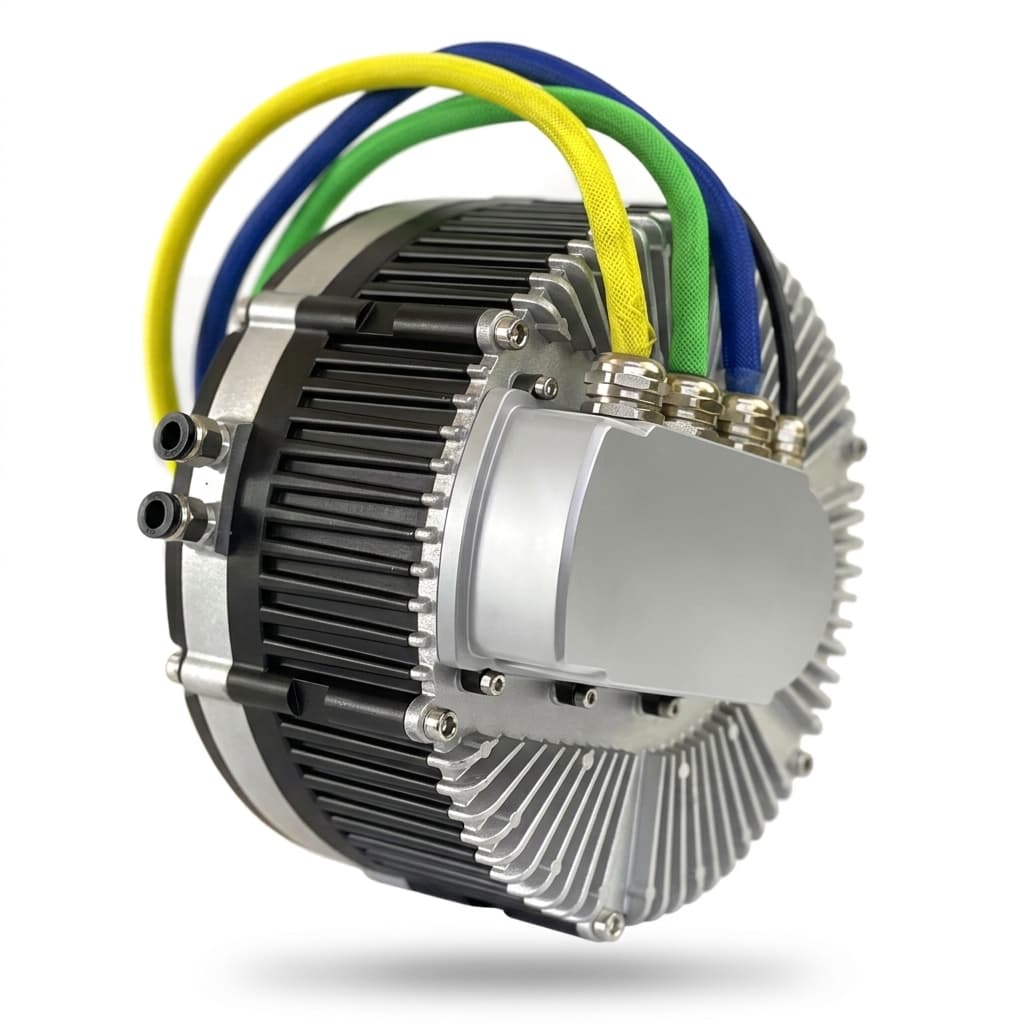
Halbach Array Magnets in Axial Flux Motor Design: When Does It Make Sense?
Technical analysis of Halbach array magnet configurations in AFPM motors — covering flux concentration benefits, manufacturing complexity, cost tradeoffs, and practical OEM sourcing guidance.
Mercedes-Benz Launches Series Production of Axial Flux Motors: Supply Chain & Procurement Impact
Mercedes-Benz begins large-scale series production of axial flux motors in Berlin. Explore the supply chain implications, technology scaling, and strategic impact for procurement and engineers.
NdFeB Magnet Grades in Axial Flux Motors: A Cost and Temperature Specification Guide for Buyers
Use this procurement guide to compare NdFeB magnet grades for axial flux motors, SH/UH/EH temperature limits, Dy/Tb cost drivers, and supplier checks.