
OEM sourcing · Reviewed
AFPM Motor Contract Manufacturing
Build a manufacturing RFQ and calculate tooling cost per unit from your quotes. Then check the process, evidence and acceptance plan before choosing a supplier.
RFQ readiness & batch budget planner
Preparing interactive planner…
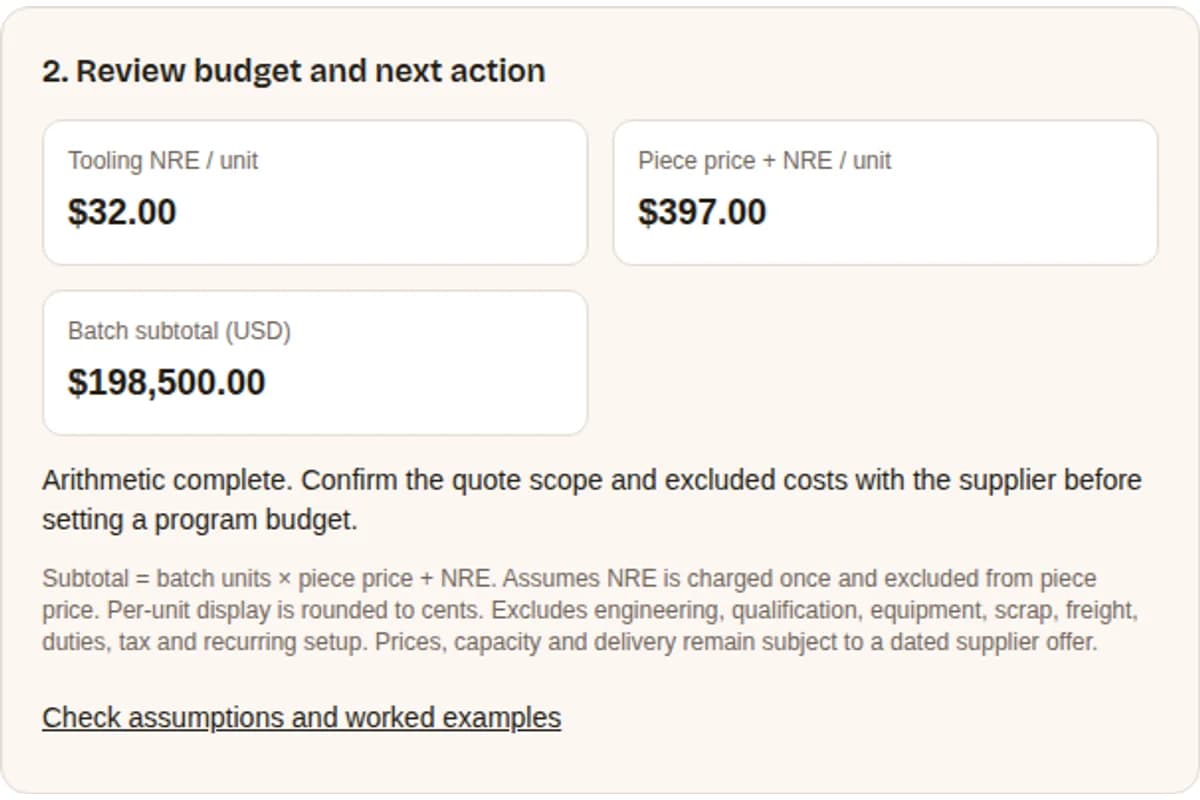
2. Review budget and next action
- Tooling NRE / unit
- Awaiting quote
- Piece price + NRE / unit
- Awaiting quote
- Batch subtotal (USD)
- Awaiting quote
Request the missing piece-price and tooling quotes. You can export the RFQ checklist now, even without prices.
Subtotal = batch units × piece price + NRE. Assumes NRE is charged once and excluded from piece price. Per-unit display is rounded to cents. Excludes engineering, qualification, equipment, scrap, freight, duties, tax and recurring setup. Prices, capacity and delivery remain subject to a dated supplier offer.
Check assumptions and worked examples3. Customize manufacturing requirements (example geometry prefilled)
Worksheet range: 60–650 mm; not a supplier capability limit.
Worksheet range: 10–200 mm; excludes end covers and shaft.
Application presets illustrate RFQ requirements, not validated motor designs. Review below changes with your selections; costs change only when you edit quoted amounts or batch quantity.
Engineering review still required
- SSDR geometry (280 mm OD × 65 mm active length): submit CAD, nominal gaps and tolerance stack; dimensions alone cannot rate an assembly fixture.
- Segmented stator: confirm core material, tooth alignment, coil handling and potting tooling; YASA-style is a topology description, not a license or affiliation.
- Composite retention: require rotor stress analysis, thermal expansion and overspeed qualification for the actual speed and geometry.
- Water jacket: specify coolant, flow, pressure, corrosion protection and leak acceptance criteria.
- Magnet N48UH: obtain the supplier datasheet and demagnetization curves at operating temperature; grade alone does not establish a safe temperature.
- IATF16949 requested: verify the candidate factory's current certificate, site and scope. Selecting this requirement does not confirm supplier certification.
- Request a dated supplier schedule covering material procurement, tooling, first article, qualification and capacity before committing delivery.
Inquiry Email
Please include application, peak/continuous torque, speed range, voltage/current limit, outer diameter, axial length, cooling method, quantity, and drawings or reference samples.
Instant Chat
WhatsApp Engineering Support
Share torque-speed, package, cooling, and sample quantity in the first message.
1. Three decisions to make before sourcing
Match the process to the design
SMC and PCB stators use different supply chains. Choose a route that can produce your released design and provide inspection evidence.
View basis and limitsBudget from a scoped quote
Separate piece price, tooling and qualification. The worked examples below show why NRE per unit changes with quantity; they do not establish market pricing.
View basis and limitsAgree the acceptance plan
Drive and winding details determine electrical test applicability. Do not transfer a grid-coil surge requirement to a converter-fed motor.
View basis and limits2. Budget method: NRE allocation is not a price forecast
Use NRE / batch quantity for tooling allocation per unit, and quantity × piece price + NRE for the batch subtotal. Both amounts must use the same currency and purchased scope. The formula is arithmetic; source prices are user inputs. Each price must be reconfirmed when quantity, geometry or manufacturing scope changes.
| Batch units | NRE / unit (USD) | Piece + NRE / unit (USD) | Batch subtotal (USD) |
|---|---|---|---|
| 100 | 160.00 | 525.00 | 52,500.00 |
| 500 | 32.00 | 397.00 | 198,500.00 |
| 1,000 | 16.00 | 381.00 | 381,000.00 |
One NRE charge is allocated across all good units in the entered batch. Per-unit results are rounded for display. Excluded: design work, validation, production equipment, yield losses, packaging, freight, duties, tax, financing and recurring setup. Confirm whether tooling is already included in the quoted piece price to avoid double counting.
Worksheet labels use 1–20 prototype, 21–250 pilot, 251–3,000 low-volume, and 3,001–100,000 mass-production units. These are organizing bins, not industry definitions, supplier capacity or MOQ commitments. Geometry bounds are software limits only.
3. What is known, and what must be confirmed?
| Item | Available on this page | Evidence still needed |
|---|---|---|
| Budget arithmetic | Reproducible from entered quantity, price and NRE | Dated quote, currency, Incoterm, validity and exclusions |
| Geometry and process | User requirement or editable example | Released CAD, tolerance stack, BOM and process trial |
| Assembly force and tolerances | No calculated fixture rating or universal gap limit | Approved electromagnetic/mechanical analysis and fixture validation |
| Lead time and capacity | Unknown; no supplier schedule supplied | Material availability, line allocation, first-article and ramp plan |
| Certification and track record | Unknown; no factory certificate or verified customer outcome supplied | Certificate site/scope, audit and authorized reference evidence |
4. Compare stator manufacturing routes
Höganäs describes SMC compaction and heat treatment for axial-flux components; ECM describes PCB stators replacing conventional windings. The comparison below turns those process distinctions into procurement questions. It does not rank untested designs. Höganäs source; ECM source.
| Route | Tooling / process to review | Tradeoff and evidence request |
|---|---|---|
| Segmented tooth / SMC | Core forming, tooth alignment, separate coil winding and potting carrier | Check core material and process access; request material data and dimensional capability on a trial lot. YASA-style describes topology, not affiliation. |
| Tape-wound slotted core | Strip/core manufacture, slot insulation and winding access | Review actual core geometry and winding accessibility; request insulation and loss validation for the operating duty. |
| PCB air-core | Copper stackup, vias, interconnects and board fabrication | Board repeatability does not establish continuous torque; request current/thermal validation and PCB inspection evidence. |
| Direct oil-contact winding | Insulation/fluid compatibility, manifolds, seals and cleanliness | Cooling is an integration choice that can overlap other stator types; qualify the actual fluid circuit and leak-test method. |
5. Release assembly fixtures and rotor retention from analysis
A diameter-only force estimate cannot establish a safe press or jig rating. Ask the design owner for attraction versus assembly position, off-center loading, stored energy, disc deflection and the approved restraint sequence. Final-machine force balance does not represent every intermediate assembly state.
For adhesive, composite or mechanical retention, request stress and thermal-expansion review, process qualification and overspeed/containment evidence. This planner supplies no safe tip-speed cutoff, rated fixture load, allowable gap, runout limit or magnet operating temperature. Those values belong in approved engineering documents. See the assembly guide for further process discussion.
6. Define a product-specific quality plan
IEC 60034-15:2025 addresses grid-connected form-wound coils and explicitly excludes converter-fed windings. IEC 60034-18-41 addresses Type I converter-fed insulation within its scope. Neither summary justifies applying one surge voltage to every AFPM motor. The responsible engineer must select the applicable standard, severity and routine-test procedure. IEC 60034-15 scope; IEC 60034-18-41 scope.
| Gate | Define in the acceptance plan | Record to request |
|---|---|---|
| Electrical winding checks | Resistance reference temperature; insulation-system qualification and applicable routine tests | Approved procedure, calibrated equipment and measured values |
| Mechanical inspection | Drawing-based runout, gap, bearing and interface dimensions | Datum scheme, measurement method and inspection results |
| Functional verification | Speed, back-EMF convention, phase sequence, feedback and load points | Traceable waveform / performance results for the agreed conditions |
| Thermal and cooling | Duty-cycle qualification; leak-test medium, pressure and acceptance where applicable | Qualification report and specified routine leak records |
| Release and traceability | Serial/lot links, deviations, sampling and customer release authority | BOM/material revisions, test record, concession and release signoff |
Separate destructive or extended type qualification from routine end-of-line screening. Passing routine checks does not establish lifetime performance or regulatory approval.
7. Verify the supplier and responsibility split
| Review area | Ask for | Decision if missing |
|---|---|---|
| Quality-system requirement | Current certificate, issuing body, site, covered activities and required customer approvals | Keep qualification pending; a selected standard is not certification |
| Process capability | Relevant trial-lot inspection, winding/potting controls and validated assembly sequence | Fund a defined process trial before committing a series order |
| Material provenance | Approved suppliers, magnet data, core/wire specifications, lot traceability and applicable declarations | Do not infer material or regulatory compliance from a grade name |
| Design ownership | Named owner for electromagnetic, mechanical, thermal, controller and test-plan approvals | Resolve responsibility before changing or releasing drawings |
| Tooling and continuity | Itemized assets, title/transfer terms, maintenance and subcontractor dependencies | Resolve access and replacement plan before paying NRE |
ISO explains that certification is assurance by an independent body. No supplier certification, partnership or product approval is verified by this page. ISO certification guidance.
8. Move from requirements to first-article approval
Ask for dated milestones and the inputs that start each activity. Raw-material lead time, tooling trials, changes after design freeze and qualification failures can shift delivery. Approve a pilot and its acceptance evidence before a larger release. A production schedule must come from the manufacturing partner.
9. Four illustrative sourcing scenarios
These examples explain a decision path. They are not customer case studies, delivered results or validated motor designs.
EV traction: 500-unit batch
Premise: Assume a segmented stator and external water jacket.
Review: Request winding/potting capability, coolant requirements and the exact site quality-system scope.
Decision / limit: With illustrative $365/unit and $16,000 NRE, batch subtotal is $198,500 before excluded costs. Actual price and delivery remain unquoted.
eVTOL: 50-unit batch
Premise: Assume an aerospace quality requirement and composite rotor retention.
Review: Identify the design-approval authority, first-article evidence and rotor qualification responsibilities.
Decision / limit: Export requirements for supplier review; no flight suitability, certification or lead time follows from the preset.
Robotic joint: 120-unit batch
Premise: Assume a PCB stator with a constrained axial envelope.
Review: Verify copper stackup, current, thermal path, interconnects and final actuator test conditions.
Decision / limit: Compare a PCB route only after thermal and continuous-duty evidence; costs remain unknown without quotes.
Industrial pump: 1,000-unit batch
Premise: Assume a slotted stator and continuous-duty cooling requirement.
Review: Agree loss map, cooling circuit, bearing arrangement and functional acceptance points.
Decision / limit: With the same illustrative costs, NRE is $16/unit; reconfirm supplier price at this batch size rather than assume a discount.
10. RFQ handoff: minimum package and next step
- Define purchased scope, application, duty cycle, peak/continuous torque-speed, voltage/current and controller.
- Supply controlled CAD/BOM revisions, envelope and interfaces, tolerance stack, cooling conditions and operating environment.
- State prototype/batch quantity separately from annual forecast, delivery destination, required date and commercial quotation scope.
- Name the design owner; agree first-article, qualification and routine acceptance plans. Record unknowns explicitly.
- Confirm NDA, file-transfer channel and tooling/IP terms before sharing proprietary documents. Attach the exported worksheet after reviewing example values.
A fixed drawing with an unverified process calls for a feasibility trial. An evolving electromagnetic design calls for development scope before a fixed manufacturing commitment. If you only need a few units, compare modification of an existing platform against custom tooling; request evidence for both options.
Inquiry Email
Please include application, peak/continuous torque, speed range, voltage/current limit, outer diameter, axial length, cooling method, quantity, and drawings or reference samples.
Instant Chat
WhatsApp Engineering Support
Share torque-speed, package, cooling, and sample quantity in the first message.
11. Contract manufacturing FAQ
SourcingWhat does AFPM motor contract manufacturing include?
Define the purchased scope: components, stator/rotor assembly, complete motor, or motor plus controller. A build-to-print order needs released drawings; a development order also needs named design responsibilities, deliverables and acceptance gates.
BudgetHow much does AFPM tooling NRE cost?
Public sources here do not establish a dependable market price. Obtain an itemized supplier quote. The worksheet divides your entered tooling amount by the batch quantity; its sample costs are illustrative, not an offer or industry benchmark.
BudgetDoes changing the batch size automatically earn a discount?
No. Quantity changes the arithmetic and NRE allocation only. Enter a supplier price quoted for that exact quantity and revision. Tier labels organize the worksheet; they are not supplier MOQs.
BudgetCan I use the planner without a quote?
Yes. Leave price fields blank and export the requirements and review checklist. Unknown is different from zero; enter zero NRE only after the supplier confirms that scope has no separate charge.
SourcingWho owns paid tooling?
Specify title, asset identification, maintenance charges, storage, access, transfer rights and end-of-program disposition in the purchase agreement. Paying NRE does not by itself establish the terms.
SourcingHow soon can first articles arrive?
A reliable date requires a supplier schedule tied to released CAD, materials, tooling and validation scope. This page does not promise a generic lead time. Ask which activities are parallel and what event starts the delivery clock.
EngineeringCan outer diameter determine magnetic fixture capacity?
No. Flux distribution, active area, rotor geometry, gap position and assembly sequence are missing. The design owner must approve the force envelope and fixture design. Balanced final-machine forces do not remove transient assembly hazards.
EngineeringIs carbon fiber mandatory above a certain tip speed?
There is no universal cutoff used here. Retention depends on rotor geometry, speed, temperature, adhesive qualification, mechanical stress and containment requirements. Request evidence for the actual operating and overspeed conditions.
EngineeringWhat air-gap tolerance and runout should I specify?
Use the approved tolerance stack including bearing play, disc deflection, thermal expansion and loaded operating conditions. A single runout number cannot serve every diameter, nominal gap and topology.
QualityIs a 2.5 kV surge test mandatory for every AFPM motor?
No. IEC 60034-15:2025 concerns grid-connected form-wound coils and excludes converter-fed machines. Select insulation qualification and routine tests for the actual winding and drive stress; IEC 60034-18-41 covers Type I systems within its scope. See the linked IEC sources.
QualityDoes selecting IATF 16949 or AS9100D confirm certification?
No. It records your procurement requirement. Request a current certificate, issuing body, covered site, activity and any customer-specific requirements. No factory certification or aerospace approval is established by this page.
HandoffWhat should I send with the RFQ worksheet?
Include the CAD/drawing revision, torque-speed map, duty cycle, voltage/current and controller, cooling conditions, quantity and forecast, delivery destination, acceptance plan and responsibility split. Share proprietary files through your agreed NDA and transfer channel.
12. Sources, dates and evidence limits
Published , reviewed . Published and maintained by AFPM Motor. Review is due by 2 May 2027, or sooner when source standards or the worksheet change. See our OEM capabilities for the wider procurement process.
Sources reviewed on 2 November 2026. Standard scope descriptions are public summaries, not substitutes for the full applicable standard or a product-specific engineering approval. Supplier pages demonstrate possible process routes; they do not verify our factory capacity, relationships, pricing or customer results. Other checklists on this page are procurement recommendations.
- IEC 60034-15:2025 — impulse testing scope
Grid-connected form-wound stator coils; excludes converter-fed machines. Replaces the 2009 edition.
- IEC 60034-18-41:2014 + AMD1:2019 — Type I insulation
Qualification and quality-control testing for Type I converter-fed insulation systems. Check voltage and insulation-system applicability before specifying tests.
- Höganäs — Somaloy axial flux manufacturing
Material supplier describes compacted, heat-treated SMC components and pre-wound coils. This is evidence for a process route, not our price or supplier relationship.
- ECM — PCB stator technology
Technology provider explains printed-circuit stators replacing wound copper. Its performance claims do not transfer to an untested design.
- ISO — certification and verification
Certification is third-party assurance; ISO itself does not certify organizations. Verify the actual factory certificate and scope.